
The Hounding of the Foxes
On 5 February 2026 the Premier League (“PL”) and the English Football League (“EFL”) announced that a PL Commission had sanctioned Leicester City FC (“LCFC”) with an immediate six-point deduction (i.e., taking effect in LCFC’s 2025/26 season in the EFL Championship) following LCFC’s breach of the EFL Profitability and Sustainability Rules (“PSR”) for the season 2023/24 (“the Decision”).[1]
For context, it should be noted that LCFC competed in the following competitions in the following seasons:
Season 2021/22 – PL
Season 2022/23 – PL
Season 2023/24 – EFL
Season 2024/25 – PL
Season 2025/26 – EFL
Further, as the PL’s statement identifies:
‘Upon [LCFC’s] promotion to the [PL] in 2024, the EFL’s investigation into [LCFC’s] alleged breaches of the [PSR] transferred to the [PL]. Following an Arbitration Tribunal’s decision in March 2025 that confirmed the [PL] had jurisdiction, [LCFC was] referred to an independent Commission in May 2025’ (“the PL Arbitration Tribunal Decision”).
The PL Arbitration Tribunal Decision is available here [2], and, whilst applying in respect of the 2023/2024 season, reflects the criticisms identified in Football Law’s article (The Premier League Outfoxed?) in respect of a PL Appeal Board’s decision from August 2024, which, at that time, resulted in that PL Appeal Board deciding that ‘[PL Rules, r. E.49] did not apply to LCFC when the PSR Calculation could be carried out and that LCFC was not in breach [of the PSR Upper Loss Threshold], and should not be treated to be in breach, of the [PL Rules 2022/23].[3]
The Decision (which runs to 100 pages) is helpfully explained in a summary of the Decision, which is available here, and which identifies, inter alia:
The relevant Upper Loss Threshold (“ULT”) for the 2023/24 season was £83 million, as identified under the EFL PSR (as opposed to the ULT of £105 million identified in the PL PSR) (“Issue 1”).[4]
LCFC breached its disclosure obligations by refusing, without justification, to provide its FY24 annual accounts (“Issue 2”).
Pursuant to rule W.52 of the PL Rules 2024/25, the PL Commission had the power to recommend a sporting sanction (i.e., a points deduction) to the EFL in respect of LCFC’s breach of the EFL PSR (“Issue 3”).
Following a determination that LCFC breached the ULT in the relevant three-year assessment period by £20.8 million, the six-point deduction was reached by identifying ‘the starting point of seven points based on the percentage overspend’ and ‘a reduction of one point reflecting LCFC’s positive financial trend in FY24 as mitigation’ (“Issue 4”).
This article will:
Summarise the background to the Decision; and
Consider the PL Commission’s approach to determining the above-stated issues and whether the PL Commission’s decision (albeit applying the EFL PSR) provides further guidance on the approach to sanction in PSR cases following several PL PSR decisions handed down since the PL Commission’s decision against Everton FC in November 2023.
(Readers will be aware that Football Law has provided several articles analysing previous decisions of PL Commissions and Appeal Boards in respect of sanctions imposed for breaches of the PL PSR, and readers are invited, at the least, to read the last of those articles published on 16 April 2024: Everton’s Double Trouble.)
It should be noted that the Decision also addressed competition law issues raised by LCFC in respect of (i) the ability of the PL to seek sanctions against LCFC based on the EFL Sanctioning Guidelines and to be imposed by and in the EFL; and (ii) the passing of investigations between the PL and the EFL and the differences in ULTs between the PL PSR and the EFL PSR. However, those issues are not considered in this article, as the PL Commission ultimately decided that the competition law arguments raised by LCFC failed.[5]
All references to the PL Rules in this article are to the PL Rules 2024/25 (edition 27 March 2025).
Relevant background
On 16 May 2025, the PL commenced disciplinary proceedings against LCFC pursuant to PL Rules, r. W.24 [6], which alleged the following:
LCFC breached the EFL PSR for the assessment period ending FY24, in that LCFC’s losses for the three-year assessment period ending in FY24 exceeded the ULT under the EFL PSR (£83 million). The PL alleged that LCFC’s losses exceeded the ULT by £23.6 million.[7]
LCFC breached its disclosure obligations pursuant to PL Rules, r. B.18, W.1 and W.16 by not providing its FY24 Annual Accounts when requested by the PL.[8]
The PL sought a sporting sanction against LCFC in the form of a ‘recommendation to the EFL to impose a points deduction against LCFC in the Championship or, alternatively in the event that the EFL was unable or unwilling to act on such recommendation, a fine’.[9] Further, the PL’s position was that the appropriate sanction should be determined ‘by reference to the EFL Sanctioning Guidelines “as well as previous cases decided under the [EFL PSR] and the [PL] PSR’.[10]
The Decision
Issue 1
The Decision brings some welcome finality to the issue of the passing of investigatory and disciplinary procedures between the PL and EFL in respect of alleged breaches of the PL PSR and EFL PSR.
The relevant PL rule to Issue 1 was r. E.77:
‘E. 77 Where a Promoted Club or any Official or Director of that Promoted Club, at the point at which it becomes a member of the League pursuant to Rule B.4, is the subject of an investigation by the EFL for alleged breaches of any aligned provision within the EFL Regulations, responsibility for that investigation will pass to the Board. In such case:
E.77.1 the Board’s power of inquiry set out in Rule W.1 will apply in full in respect of the investigation (with the reference to ‘these Rules’ in Rule W.1 deemed to include the relevant aligned EFL Regulations); and
E.77.2 the Board’s disciplinary powers set out in Section W (Disciplinary) of these Rules will apply in full in respect of the matter (with the reference to ‘these Rules’ in Rule W.3 and W.7 deemed to include the relevant aligned EFL Regulations.
Further, the relevant EFL regulation to Issue 1 was reg. 87.4:
‘87.4 Where a Promoted Championship Club, or any Official or Director of that Promoted Championship Club, at the point at which it becomes a member of the Premier League, is subject to an investigation by The League for alleged breaches of any aligned provisions within the Premier League Rules, the responsibility for that investigation will pass to the Premier League and the provisions of that Premier League Rule will apply’.
LCFC argued the following in respect of those provisions:
‘237.1 The opening paragraph of Rule E.77 of the 2024/25 PL Rules provides simply that responsibility for an investigation into “alleged breaches of any aligned provisions within the EFL Regulations” shall pass to the PL. It does not set out the “basis upon which that investigation will then continue”.
237.2 The reference of “the relevant aligned EFL Regulations” in E.77.1 and E.77.2 is a deliberate reference to “all” relevant aligned EFL Regulations, not just to those regulations “of which breach was alleged in the investigation”. The “aligned EFL Regulations” include EFL Regulation 87.4.
237.3 EFL Regulation 87.4, in turn, provides that, upon transfer, “the Provisions of that Premier League Rule will apply”. The effect is that upon transfer, the [EFL PSR] are to be modified to reflect the content of the [PL] PSR in relation the transferred investigation’.[11]
Consequently, LCFC submitted that if the PL PSR applies, LCFC could benefit from the higher ULT available under the PL PSR of £105 million, compared to the ULT under the EFL PSR of £83 million.
Bearing in mind the PL Arbitration Tribunal Decision as referred to above, the PL Commission decided, inter alia:
‘244. Our reading of the award of the [PL Arbitration Tribunal Decision] is that it gives rise to issue estoppel. In that award, the […] Tribunal held at [103] that the PL had “jurisdiction under Rule E.77 of the 2024/25 Premier League Rules to investigate an alleged breach by LCFC of the [EFL PSR] in force for the 2023/24 Season”. That conclusion proceeded expressly on the basis that the reference to “aligned provisions” in Rule E.77 was a reference to the [EFL PSR] (at [92]).
245. Although the [PL Arbitration Tribunal Decision] was primarily concerned with the issue of jurisdiction, its reasoning necessarily addressed the scope and meaning of Rule E.77 for the purpose of identifying the regulatory framework governing the alleged breach. As we understand it, the determination of the meaning of “aligned provisions” was, therefore, “essential to the disposition” of the jurisdictional issue in the [PL Arbitration Tribunal Decision …].
246. In these proceedings, LCFC seeks to advance a construction of the same rule – Rule E.77 – read together with EFL Regulation 87.4, to contend that the PL must now apply the substance of the [PL] PSR to the assessment. That proposition is inconsistent with what was already decided in the [PL Arbitration Tribunal Decision] and would, if accepted, undermine the earlier determination. We therefore conclude that the requirements of issue estoppel are satisfied and that LCFC is precluded from advancing before the Commission its contention that the applicable rules are the 2024/25 PL Rules and not the [EFL PSR]’.[12]
The PL Commission went further in also considering whether LCFC’s position was tenable upon construction of PL Rules, r. E.77. Applying the well-known principles of contractual interpretation (see in particular Arnold v Britton [2015] UKSC 36, [15] (Lord Neuberger PSC)), the PL Commission dismissed LCFC’s construction:
‘251. […] the phrase “aligned provisions” in the main body of Rule E.77 refers to those EFL Regulations that are capable of being breached. There is no reason to attribute different meanings to the same phrase within a single rule. In a carefully drafted contract of this kind, it is generally to be expected that “words and phrases will have been used in a consistent manner, in the absence of an identified reason for giving the same word a different meaning” (Chitty on Contracts, 36th ed., at 16-077).
252. The same meaning therefore attaches to the phrase “relevant aligned EFL Regulations” in Rules E.77.1 and E.77.2. EFL Regulation 87.4 is not capable of breach; it operates as a procedural gateway for the transfer of jurisdiction. Its function is different in kind from the [EFL PSR] provisions the alleged breach of which gives rise to the investigation. It would be linguistically strained to characterise a provision that is not capable of breach as one being “investigated” under Rule E.77. Accordingly, “relevant aligned EFL Regulations” refer to the [EFL PSR], not to EFL Regulation 87.4.
253. This interpretation accords with the commercial and regulatory purpose of Rule E.77. The rule operates as a jurisdictional bridge (indeed, that is what the parties called the rule), ensuring that an alleged breach committed while a club was competing in the Championship remains capable of investigation and sanction notwithstanding the club’s promotion to the Premier League. It does not operate to rewrite the applicable financial limit by reference to the rules of the league to which the club has subsequently moved. Had that been the parties’ intention then no doubt they would have said so’.[13]
It is difficult to imagine how there is likely to be any future jurisdictional challenge raised by a club facing investigations in respect of an alleged breach of the PL PSR or the EFL PSR when passing between the PL and the EFL. That door appears to now be firmly closed. The same also appears to apply to the contention that the mere passing of an investigation between the PL and the EFL affects and/or changes the PSR being applied for the purposes of that investigation (and any subsequent charge).
Issue 2
The PL’s position on Issue 2 was straightforward; LCFC had refused to provide its FY24 accounts to the PL ‘despite requests by the PL by email dated 2 January 2025, 7 January 2025, 8 January 2025 and 13 January 2025, and by application to the [PL Arbitration Tribunal]’.[14] The PL contended that this amounted to breaches of PL Rules, r. B.18, W.1 and/or W.16.[15] Those rules state:
‘B.18 Without prejudice to the League’s powers of inquiry under rule W.1, each Club shall comply promptly and in full with any request for information and/or documents made by the League (including, for the avoidance of doubt, any such request made pursuant to demand from a statutory or regulatory authority’.
‘W.1 The Board shall have power to inquire into any suspected or alleged breach of these Rules and for that purpose may require:
W.1.1 any Manager, Match Official, Official or Player to appear before it to answer questions and/or provide information; and
W.1.2 any such person or any Club to produce documents’.
‘W.16 It shall be no answer to a request from the Board to disclose documents or information pursuant to Rule W.1 that such documents or information requested are confidential. All Clubs and Persons subject to these Rules must ensure that any other obligations of confidentiality assumed are made expressly subject to the League’s right of inquiry under these Rules. No Club or Person shall be under an obligation to disclose any documents rendered confidential by either the order of a court of competent jurisdiction or by statute or statutory instrument’.
LCFC raised several defences to Issue 2 which included, inter alia:
That ‘the PL had no good reason to request the FY24 Annual Accounts in advance of 31 March 2025, particularly where LCFC had confirmed its intention to provide those accounts by that date’ [16]; and
That ‘the PL acted unreasonably in seeking information it did not require, and that LCFC acted reasonably in withholding disclosure for a short period while the [PL Arbitration Tribunal Decision] was ongoing, given those proceedings concerned the threshold issue of whether the PL had jurisdiction to pursue disciplinary action at all’.[17]
The PL Commission rejected LCFC’s defences, and accepted the PL’s position for, inter alia, the following reasons:
‘307. On the evidence before us, we are satisfied that the PL had reasonable and proper grounds for seeking [LCFC’s] FY24 Annual Accounts when it did. At the time of the requests in January 2025, the PL was actively considering LCFC’s financial position, including potential breaches of the [EFL PSR], and was seeking to manage and, if possible, expedite disciplinary proceedings against [LCFC]. The fact that LCFC had indicated an intention to submit its accounts by 31 March 2025 does not negate the PL’s entitlement to seek earlier disclosure in pursuit of its regulatory functions. This was the date on which the accounts would have been submitted to the Companies House anyway and become a public document.
308. Furthermore, neither the FY23 Proceedings nor the [PL Arbitration Tribunal Decision] suspended LCFC’s ongoing obligations to provide information under the PL Rules. In these circumstances, repeated refusal to provide information reasonably sought by the PL is capable of prejudicing the effective and timely operation of the disciplinary process. We therefore find that LCFC’s failure to provide the FY24 Annual Accounts upon request amounted to a breach of its disclosure obligations under the 2024/25 PL Rules’.[18]
Whilst the PL Commission found that LCFC had breached its disclosure obligations in respect of the PL’s request for LCFC’s FY24 accounts, it was not considered appropriate to impose a separate and/or additional sanction on LCFC in respect of the same. Instead, the PL Commission took ‘LCFC’s conduct in this respect into account when considering aggravating (and mitigating) factors for the purposes of determining the appropriate sanction for the breach of the [EFL PSR]’.[19]
Issue 3
In respect of Issue 3, the PL’s case was that, inter alia, PL Rules, r. W.52 provided the PL Commission with the power to recommend sanctions to the EFL:
‘W.52 Having heard and considered such mitigating factors (if any) the Commission may:
[…]
W.52.4 In the case of a Respondent which is a Club:
[…]
W.52.4.2 deduct point scored or to be scored in League Matches […]
W.52.7 impose upon the Respondent any combination of the foregoing or such other penalty as it shall think fit;
[…]
W.52.10 in the case of a Respondent which is no longer a member of the League at the point at which any sanction is to be imposed, make a recommendation to the Football League, or any Football League Club Financial Review Panel, Football League Arbitration Panel or Disciplinary Commission constituted in accordance with the EFL Regulations (as applicable), as to the sanction that should be imposed on the club; and/or
W.52.11 make such other order as it thinks fit’ (emphasis added).[20]
LCFC contended, inter alia, that the PL Commission lacked power to recommend a sanction in the EFL Championship ‘because that power was introduced only by [an amendment …] made on 27 March 2025, whereas the alleged breached concerned FY24 with a year-end of 30 June 2024’.[21] In such circumstances, LCFC submitted that ‘there is “a strong presumption” in sports law that the determination of what sanctions can be imposed must be done in accordance with the law in effect at the time of the allegedly sanctionable conduct’.[22]
LCFC also contended that the PL Commission’s powers to ‘make such other order as it thinks fit’ or to ‘impose […] any combination of the foregoing or such other penalty as it shall think fit’ do not include ‘a power to recommend sanctions to the EFL’ (emphasis original).[23]
Further, LCFC also contended that the EFL ‘lacked power to impose any sanction recommended by the Commission, because Regulation 88.7 of the EFL Regulations conferring such power was introduced only in April 2025, after the date of the alleged breach’.[24]
The PL Commission first noted that the PL Rules constitute a contract between the PL and its members, being the clubs participating in and who are a shareholder of the PL, and between each of those member clubs.[25] PL Rules, r. B.14 expressly states this:
‘Membership of the League shall constitute an agreement between the League and Club (both on its own and on behalf of its Officials) and between each Club to be bound by and comply with:
[…]
B.14.4 These Rules
[…]
each as amended from time to time’.
The PL Commission then emphasised that ‘[there] is no rule of English [and Welsh] law that a contract cannot have retrospective effect […] rather, the question is one of construction’.[26] The PL Commission noted that PL Rule, r. W.52.10 ‘contains no express temporal limitation. Nothing on its face confines its operation to breaches arising after its introduction. Its language is neutral, conferring a power of general application’.[27]
Further, and seemingly in the alternative to that contractual position, the PL Commission considered the presumption against retroactivity as raised by LCFC:
‘358. […] we found assistance in McTier and R v Field [2002] EWCA Crim 2913. In both cases, regulatory sanctions […] were imposed for conduct that predated the enactment of the sanctioning power. In both cases it was held that the statutory provisions were “temporally general” (Field at [60]) and the form of retroactivity involved was of a “weak form”. As held in McTier at [75]:
“In this case, the form of retroactivity contended for is not the strong form where vested or accrued rights are retrospectively taken away; but a weak form involving only the application of an adjusted sanctions regime to conduct of the type which, in a broad sense, was already the subject of a similar though narrower sanctions regime at the time of the conduct complained of.”
359. There is therefore a substantive difference between (a) what is called the strong form of retroactivity where vested rights are retrospectively abrogated and (b) a weak form of retroactivity which involves no vested rights but only the application of a different sanctions regime to conduct which was already the subject of a (narrower) sanction regime at the time of the conduct.
360. We adopt that approach here […] To the extent that Rule W.52.10 applies to past conduct, it engages only the “weak form” of retrospectivity described in McTier; the conduct complained of against LCFC was already the subject of [a] sanctions regime, albeit one that was slightly narrower. The conduct complained of – i.e., breach of the [EFL PSR] by exceeding the permitted losses – was already the subject of a sanctions regime (including of course the imposition of a sporting sanction and/or a fine) and all that was expressly added was the power on the part of a commission to make a recommendation to the EFL as to the sanction that should be imposed on the club by the EFL’.[28]
This is also consistent with sports disciplinary bodies’ and the Court of Arbitration for Sport’s application of the principle of tempus regit actum.[29]
For those reasons, inter alia, the PL Commission concluded that PL Rules, r. W.51.20 was available in respect of LCFC’s breach of the EFL PSR in FY24.[30]
Issue 4
Following the above and a determination that LCFC had breached the ULT by £20.8 million, the PL Commission was then required to identify its approach to sanction and determine the appropriate sanction to impose on LCFC.[31]
As identified in Football Law’s article Everton’s Double Trouble, following the PL Commission’s decision in The Football Association Premier League Limited (t/a The Premier League) v Everton Football Club Company Limited, Premier League Commission (Ch. James Drake KC), 8 April 2024, and previous decisions, there appeared to be a 14-point approach to sanction for a breach of the ULT in the PL PSR:
‘1. A Commission or Appeal Board (as the case may be) will have in mind the purposes and disciplinary aims of the PSR. The purpose of PSR is to provide a disciplined framework within which football clubs work within to avoid unsustainable spending and jeopardising the club and the integrity of the PL. The disciplinary aims are punishment, vindication of compliant clubs, deterrent, and integrity, albeit punishment is not the most important aim.
2. Firstly, A breach of the PSR is very likely to result in a points deduction, with the starting point being a three-point deduction.
3. Secondly, a Commission or Appeal Board will then consider the quantum of the breach beyond the PSR upper loss threshold, and there is to be a further one point added to the starting point for every £6.5 million above the PSR upper loss threshold.
4. When considering steps one and two, a Commission or Appeal Board should bear in mind available benchmarks, including (i) the comparable sanction of an immediate nine-point deduction for an Event of Insolvency under PL Rules, r. E. 37; (ii) the EFL Sanctioning Guidelines; and (iii) comparable cases, albeit each case turns on its own facts.
5. Thirdly, a Commission or Appeal Board will consider any mitigating or aggravating factors, which may deduct or add to the starting point. Circumstances are only mitigating or aggravating factors when marked against the aims of the PSR. Business decisions, the consequences of a points deduction, previous compliance with financial fair play rules, and a positive trend beyond the relevant three-year reference period will not amount to mitigating factors.
6. Where a club has previously been sanctioned for a PSR Calculation that resulted in a breach of the PSR upper loss threshold, financial years included in that PSR Calculation that appear in a subsequent PSR Calculation that results in a further breach of the PSR upper loss threshold will be discounted on a proportionate basis from the points deduction that would otherwise be imposed.
7. A sporting advantage is to be presumed where there has been a breach of the PSR upper loss threshold. However, while difficult in practice, this presumption is rebuttable and if rebutted may act as a mitigating factor.
8. Whilst a near miss with a deadline that affects a club’s PSR Calculation can amount to a mitigating factor, clubs should ensure compliance with deadlines.
9. If a club admits its breach of the PSR upper loss threshold at the earliest opportunity, the club will be entitled to a reduction of up to one third from the starting point. The value of any reduction will decrease the more time that passes from the earliest opportunity to provide an admission.
10. If a club provides exceptional cooperation in line with the conduct seen by NFFC and recorded in the NFFC Commission Decision, then this will amount to mitigation.
11. If a club can demonstrate that losses in years T and/or T-1 are lower than T-1 and/or T-2 (as the case may be), then this would be a positive trend and amount to mitigation.
12. Previous breaches of the PSR and the extent of the PSR breach can amount to an aggravating factor.
13. After applying mitigating and/or aggravating factors, the Commission or Appeal Board will again consider the proposed sanction against available benchmarks.
14. It is unlikely that any points deduction, or any part of a points deduction, will be suspended’ (“Football Law’s Approach to Sanction”).
In LCFC’s case, the PL Commission appear to have recognised an approach consistent with Football Law’s Approach to Sanction up to a point, as there is one obvious difference between those previous cases considered in Everton’s Double Trouble and LCFC’s case: LCFC’s case concerned a breach of the EFL PSR rather than the PL’s PSR.[32]
Accordingly, the PL Commission applied some EFL PSR-specific variation to points 2 and 3 above, as a breach of the EFL’s PSR requires consideration and application of the EFL’s Sanctioning Guidelines (save that a disciplinary commission may find reasons to depart from the Sanctioning Guidelines in appropriate circumstances).
The Decision helpfully sets out the EFL Sanctioning Guidelines in full.[33] In summary, the EFL Sanctioning Guidelines provide that a breach of the EFL PSR ULT will result in a 12-point deduction, subject to a gradated reduction depending on the quantum of the breach (i.e., there will be a nine-point reduction where the breach is less than £2 million (resulting in a three-point deduction), an eight-point reduction where the breach is between £2 million and £4 million (resulting in a four-point deduction) et seq). The EFL Sanctioning Guidelines also provide for the application of mitigating and aggravating factors (as also seen in Football Law’s Approach to Sanction).
During evidence for the PL, Mr Nicholas Craig, COO at the EFL, the PL Commission noted the following that Mr Craig stated in respect of the EFL Sanctioning Guidelines:
‘66. […] He accepted that they are “only guidelines” and that a commission “may find reasons to depart from guidelines”. In response to a question as to whether any consideration had been given to breaches of higher ULTs, for example of £61m or £83m, he said that the guidelines were designed to operate by reference to quantum rather than percentage, although he accepted “with the benefit of hindsight” that “percentages might be an alternative way of doing it”’.[34]
Bearing that evidence in mind, the PL Commission stated the following:
‘382. Critically, the EFL Sanctioning Guidelines are based on an assumption of the standard ULT of £39 million under the [EFL PSR]. They do not accommodate (at least not obviously so) the Variable ULT. In this case, the applicable ULT is £83 million, which is more than double the standard [EFL PSR] ULT. An overspend of (for example) £10 million against a £39 million ULT may reasonably be regarded as materially more serious than an equivalent £10 million overspend where the applicable ULT is £83 million.
383. Applying the same baseline deduction in both scenarios, without regard to the applicable ULT, would, in our view, distort the proportionality of the sanction and significantly overstate the relative seriousness of a breach under the higher threshold. The PL advanced two ways in which to reflect the Variable ULT. The first was to apply the EFL Sanctioning Guidelines, adjusted to percentage overspend on a relative scale; and the second was to follow the approach taken in Everton II, where the commission imposed a three-point baseline sanction for the fact of the breach to which were added further points calculated by reference to the percentage overspend.
384. Given that we are here dealing with the breach by a Championship club of the [EFL PSR] we consider that the former approach is to be preferred as it better reflects the particular context of the particular club’s conduct […]’.[35]
Accordingly, the PL Commission also helpfully provided an adjusted version of the EFL Sanctioning Guidelines that includes a percentage overspend on a relative scale to assist with identifying the appropriate reduction to be made to the starting point of a 12-point deduction when dealing with a breach of the EFL PSR ULT [36]:
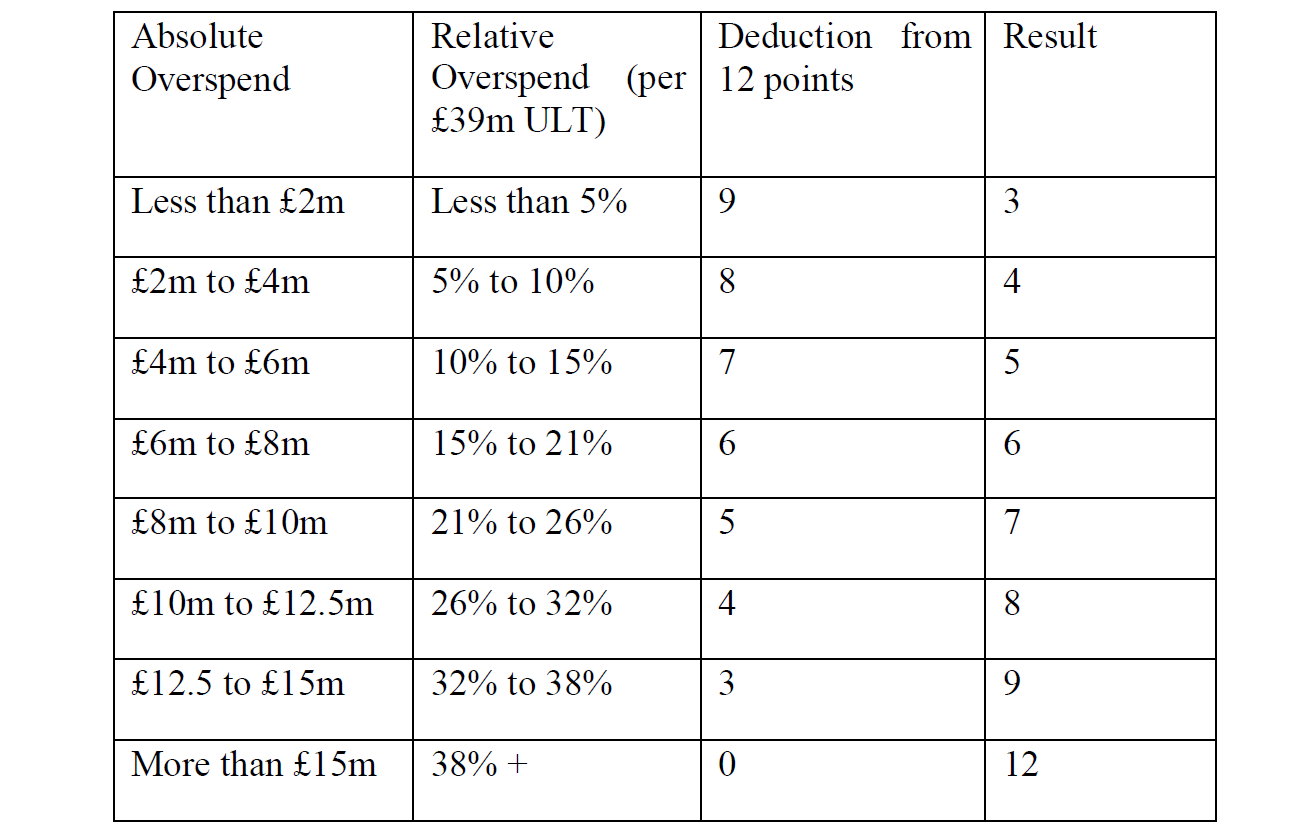
Considering that LCFC breached the EFL PSR ULT by £20.8 million, LCFC’s relative overspend was 25%, resulting in a seven-point deduction.[37] It is also notable that even if the PL Commission had applied points 2 and 3 of Football Law’s Approach to Sanction (i.e., a starting point of a three-point deduction, to be increased by one point for every £6.5 million / c. 6.67% relative overspend above the PL PSR ULT), that method of calculation would also have resulted in a seven-point deduction.[38]
When considering LCFC’s mitigation, the PL Commission noted that it was ‘common ground that LCFC has demonstrated a positive trend in its finances, namely that LCFC moved from an adjusted loss of £63.8 million in FY23 to an adjusted profit of £6.1 million in FY24’.[39] The PL Commission considered that ‘this positive trend merits a reduction of one point’, consistent with point 11 of Football Law’s Approach to Sanction, and the EFL Sanctioning Guidelines which expressly provide for a one-point reduction in such circumstances.[40]
Further, the PL Commission rejected LCFC’s assertion that LCFC had demonstrated ‘exceptional cooperation’ in reliance upon point 10 of Football Law’s Approach to Sanction, for the following reasons:
‘396. We do not consider LCFC’s conduct to meet, or indeed to come close to, that benchmark.
396.1 LCFC did not consistently adopt or maintain a position that assisted the expeditious resolution of these proceedings. Its protestations of admission of breach were qualified and accompanied by myriad arguments that, in material respects, denied liability. As in life and politics, one cannot have one’s cake and eat it too.
[…]
396.3 As determined above at paragraph 304, LCFC breached its disclosure obligations. Quite apart from cooperation, LCFC manifestly refused to cooperate by not providing its accounts […] LCFC had no positive reason for not disclosing its accounts upon the PL’s requests other than deference to its legal advice […] the accounts were signed off in December 2024. It was not for [LCFC] to refuse disclosure on the basis that, in its own assessment, the PL had no genuine need for the accounts. Instead, [LCFC] was expected to provide its accounts as and when required by the PL pursuant to the PL Rules. LCFC’s approach to the PL’s requests for its final accounts was not comparable to the proactive, early, and facilitative disclosure described in Nottingham Forest’.[41]
Accordingly, no further reduction was made, and the PL Commission sanctioned LCFC with an immediate six-point deduction (or made a recommendation to the EFL to that effect) for LCFC’s breach of the EFL PSR for the season 2023/24.
(It should be noted that the PL Commission also proceeded to sanction LCFC with a £9.6 million fine, only to become payable should the EFL be unwilling or unable to accept the six-point deduction recommendation. As the EFL has ultimately accepted the six-point deduction recommendation – and whilst the Decision provides helpful guidance on how such an alternative fine is to be calculated – any explanation or analysis of the same for present purposes would be academic and is not provided in this article.[42])
Conclusion
The Decision does not substantively change Football Law’s Approach to sanction, but it does provide an example of a consistent approach, and a helpful development of how the same is to apply and/or be partially modified in circumstances where a club is being sanctioned for a breach of the EFL PSR ULT.
Further, it is helpful to have finality on the points surrounding Issue 1, and it is likely that clubs will be unable to raise jurisdictional challenges of the sort previously raised by LCFC where the responsibility for investigating alleged breaches of the PL PSR or the EFL PSR has passed between the PL and the EFL.
Finally, it should be noted that appeals were made by LCFC and the PL in respect of the Decision on various grounds. However, the PL Appeal Board dismissed each ground of appeal and the Decision was upheld.[43] The PL Appeal Board’s decision is available here.
Footnotes
[1] The Premier League Board v Leicester City Football Club, Premier League Commission (Ch. James Drake KC), 3 February 2026.
[2] The Football Association Premier League Limited v Leicester City Football Club, Premier League Arbitration Tribunal (Ch. Michael Crane KC), 19 May 2025.
[3] The Premier League v Leicester City Football Club Limited, Premier League Appeal Board (Ch. Rt Hon Sir Stanley Burnton), 30 August 2024, [59].
[4] The £83 million ULT is calculated by reference to LCFC having a permitted Annual Upper Loss Threshold of £35 million for the 2021/22 season and the 2022/23 season, and £13 million for the 2023/24 season; see EFL Regulations, Appendix 5, Financial Fair Play Rules, Part 1 – Championship PSR, r. 3.1.
[5] (n1), [125]-[126] and [169]-[235].
[6] (n1), [10].
[7] Ibid, [20.1].
[8] Ibid, [20.2].
[9] Ibid, [21].
[10] Ibid.
[11] (n1).
[12] Ibid.
[13] Ibid.
[14] Ibid, [296].
[15] Ibid.
[16] Ibid, [301].
[17] Ibid, [302].
[18] (n1).
[19] Ibid, [309].
[20] Ibid, [310]-[315].
[21] Ibid, [330].
[22] Ibid, [331].
[23] Ibid, [333].
[24] Ibid.
[25] Ibid, [355].
[26] Ibid, [356].
[27] Ibid, [357].
[28] (n1).
[29] The FA v Mikkel Beck, FA Appeal Board (Ch. Louis Weston), 28 April 2022, [62]-[63]; CAS 2004/A/635 RCD Espanyol de Barcelona SAD v Club Atlético Velez Sarsfield, [11].
[30] (n1), [367].
[31] Ibid, [257]-[294].
[32] Ibid, [373]-[377] and [388].
[33] Ibid, [42].
[34] (n1); see also [379].
[35] Ibid.
[36] Ibid, [386].
[37] Ibid, [387].
[38] Ibid, [388.4].
[39] Ibid, [392].
[40] Ibid.
[41] (n1).
[42] Ibid, [399]-[413].
[43] The Board of The Football Association Premier League Limited v Leicester City Football Club Limited, Premier League Appeal Board (Ch. Lord Dyson), 6 April 2026.
5 May 2026